
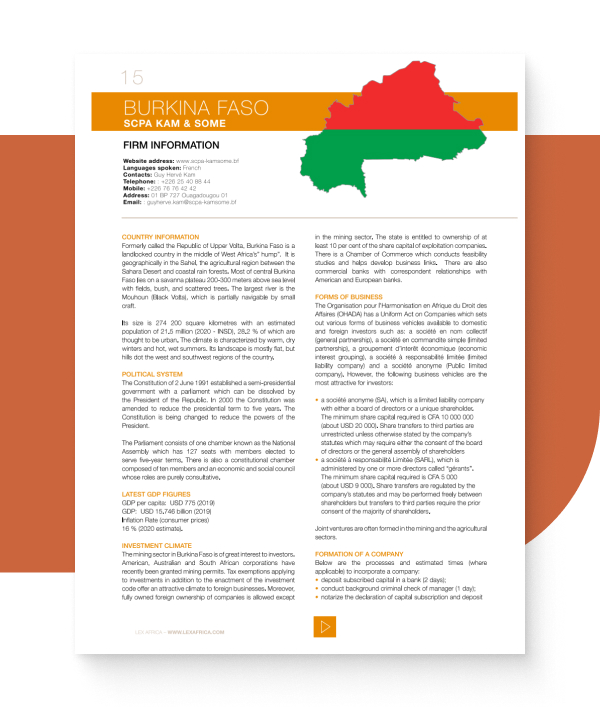
This guide provides a practical overview of doing business in Burkina Faso for investors, companies and advisers. It covers the legal framework, Burkina Faso’s political system, key economic indicators, tax and exchange control rules, as well as sector-specific information on mining, agriculture, transport, energy, telecommunications and insurance.
For organisations interested in setting up a business in Burkina Faso or expanding an existing presence, this guide highlights the main procedures, risks and business opportunities in Burkina Faso. It is designed to support both local and foreign investors who are considering investing in Burkina Faso or looking for cross-border legal support.
COUNTRY INFORMATION
Formerly called the Republic of Upper Volta, Burkina Faso is a landlocked country in the middle of West Africa’s “hump”. It is geographically in the Sahel, the agricultural region between the Sahara Desert and the coastal rain forests. Most of central Burkina Faso lies on a savanna plateau 200 to 300 metres above sea level with fields, bush and scattered trees. The largest river is the Mouhoun (Black Volta), which is partially navigable by small craft.
Its size is 274 200 square kilometres with an estimated population of 24,436,925 (2025, INSD), 34.5% of which are thought to be urban. The climate has warm, dry winters and hot, wet summers. Its landscape is mostly flat, but hills dot the west and southwest regions of the country.
POLITICAL SYSTEM
The Constitution of 2 June 1991 established a semi-presidential government with a parliament that can be dissolved by the President of the Republic. In 2000, the Constitution was amended to reduce the presidential term to five years. The Constitution is being changed to reduce the powers of the President.
The Parliament consisted of one chamber known as the National Assembly, which had 127 seats with members elected to serve five-year terms. However, following political developments and regime changes since 2022, the National Assembly has been dissolved and is currently being replaced by the People’s Legislative Assembly. There is also a constitutional chamber composed of ten members and an economic and social council whose roles are purely consultative.
Understanding Burkina Faso’s political system is important for investors and businesses that are assessing political risk, regulatory stability and the broader context for doing business in Burkina Faso.
LATEST GDP FIGURES
Current GDP per capita: USD 1,147.6 (2025)
GDP: USD 32.51 billion (2026)
Inflation rate (consumer prices): 1.5% (2026)
INVESTMENT CLIMATE
The mining sector in Burkina Faso is of great interest to investors. American, Australian and South African corporations have been granted mining permits. Tax exemptions that apply to investments, together with the investment code, offer an attractive climate to foreign businesses and support foreign investment in Burkina Faso.
Fully owned foreign companies are allowed, except in the mining sector. In mining, the state is entitled to ownership of at least 15% of the share capital of exploitation companies. There is a Chamber of Commerce that conducts feasibility studies and helps develop business links. There are also commercial banks with correspondent relationships with American and European banks.
FORMS OF BUSINESS
The Organisation pour l’Harmonisation en Afrique du Droit des Affaires (OHADA) has a Uniform Act on Companies that sets out various forms of business vehicles available to domestic and foreign investors. These include: a société en nom collectif (general partnership), a société en commandite simple (limited partnership), a groupement d’intérêt économique (economic interest grouping), a société à responsabilité limitée (limited liability company) and a société anonyme (public limited company).
However, the following business vehicles are the most attractive for investors that are starting a business in Burkina Faso or expanding an existing operation:
- a société anonyme (SA), which is a limited liability company with either a board of directors or a unique shareholder. The minimum share capital required is CFA 10,000,000 (about USD 20,000). Share transfers to third parties are unrestricted unless otherwise stated by the company’s statutes, which may require either the consent of the board of directors or the general assembly of shareholders
- a société à responsabilité limitée (SARL), which is administered by one or more directors called “gérants”. The minimum share capital required is CFA 5,000,000 (about USD 9,000). Share transfers are regulated by the company’s statutes and may be performed freely between shareholders, but transfers to third parties require the prior consent of the majority of shareholders.
Joint ventures are often formed in the mining and agricultural sectors.
FORMATION OF A COMPANY
Below are the processes and estimated times (where applicable) to incorporate a company:
- Deposit subscribed capital in a bank (two days)
- Conduct a background criminal check of the manager (one day)
- Notarise the declaration of capital subscription and deposit the two acts at the notary office within three days
- Register at the Centre des Formalités des Entreprises (CEFORE) for a company registration tax number (IFU) and social security number (seven days)
- Submit a single application form to complete the company registration with the Trade Register and Personal Credit Bureau (RCCM) and obtain the fiscal and the professional licence at the Ministry of Commerce
- Once the form is submitted, CEFORE organises the registration with the court and other authorities. Companies are assigned a unique company identification number for company registration, fiscal identification and social security affiliation.
The official time for the completion of the registration process is seven working days. However, it often takes longer in practice because CEFORE forwards the documents to the relevant authorities.
Publication can be made directly on the CEFORE website for a fee of CFA 10,000 (about USD 17) or in an official newspaper at a cost that varies depending on the newspaper chosen, but is generally about 82,010 CFA francs (approximately USD 146.35). Costs for completing the formalities for the incorporation are CFA 50,500 (about USD 86.25). However, the CFA 50,500 amount is paid to CEFORE and does not include all the incorporation fees, which may be higher and depend on the amount of the share capital.
These steps are relevant for anyone setting up a business in Burkina Faso.
EXCHANGE CONTROLS
Foreign investors are entitled to transfer all funds from the business, dividends and receipts from liquidation, assets and wages. However, transfers must be completed through authorised financial intermediaries. Exchange controls are primarily regulated by the rules of the West African Economic and Monetary Union. Transfers are authorised in the original currency of the investment.
TAXATION
Mandatory taxes to be paid by a company per annum are as follows:
- Corporate income tax (27.5% of net profit)
- Social security contributions (16% of gross salary)
- Business licence (8% plus a fixed amount)
- Payroll and apprentice tax (3% of gross salary)
- Capital gains tax (10%) and 20% for the mining sector
- Mortmain property tax (10%)
- Tax on insurance contracts, if any (20%)
- Stamp duty on contracts (CFA 400, about USD 0.33 per page)
- Value Added Tax (18%)
- Motor vehicle tax, if any (CFA 50,000, about USD 84, based on the weight of the truck).
Burkina Faso’s customs fees are based on goods ad valorem and include a 5% customs fee, an import fiscal duty and a value added tax based on the type of equipment.
IMPORT/EXPORT
Imports account for USD 8.29 billion of the economy and consist mainly of machinery, agricultural products, electrical goods and petroleum. Exports account for USD 9.67 billion and consist mainly of agricultural goods, cotton, livestock and shea butter. Gold is an important export.
MONETARY POLICY
Burkina Faso’s monetary policy is largely based upon liberalisation. It is determined by the Central Bank of West African States (BCEAO), whose priority is to control inflation. Its monetary policy remains influenced by the European Central Bank, as the CFA franc is pegged to the Euro. Burkina Faso’s BCEAO-led monetary policy is accordingly strongly influenced by the monetary policy conducted in the Eurozone.
LEGAL SYSTEM
The legal system is based on the French civil law system. The judicial system is made up of two branches: the judiciary branch and the administrative branch. At the top of the judiciary branch is the Cour de Cassation.
Beneath it are three courts of appeal (at Ouagadougou, Bobo-Dioulasso and Fada N’Gourma) and 28 tribunals (Tribunal de Grande Instance), the most important being in Ouagadougou, Bobo-Dioulasso, Ouahigouya and Fada N’Gourma, which deal with cases involving civil and criminal law. At the same level are the Tribunal de Commerce (tribunal of commerce) at Ouagadougou and Bobo-Dioulasso, dealing with commercial law, and the Tribunal du Travail (labour court) at Ouagadougou, Bobo-Dioulasso and Koudougou.
At the top of the administrative branch is the Conseil d’Etat. Beneath it are three administrative courts of appeal (at Ouagadougou, Bobo-Dioulasso and Fada N’Gourma) and 28 administrative tribunals, which deal with cases involving administrative law. There is also a High Court of Justice to try the President for treason and ministers for crimes.
The constitution provides for a number of safeguards, including a right to a public trial, a right of access to counsel and a right to appeal.
Judges serving in the courts are divided into trial judges and prosecutors. Judges are appointed by a simple decree of the President, who also determines their place of assignment. The High Council of the Judiciary (CSM) plays a central role in managing the careers of judges. It decides on the appointment and assignment of judges of the Court of Cassation, the Council of State and the Court of Auditors, as well as those of the chief judges of the courts of appeal. It also provides its opinion on proposals from the Minister of Justice regarding the appointment of other judges. Prosecutors, on the other hand, are appointed and assigned upon the recommendation of the Minister of Justice.
INTELLECTUAL PROPERTY
Burkina Faso is part of both the African Intellectual Property Organisation or Organisation Africaine de la Propriété Intellectuelle (OAPI) and the World Intellectual Property Organisation (WIPO). The OAPI amended the Bangui Protocol of 1977, which sets out common procedures based on a uniform system of protection, in addition to provisions included in international conventions to which member states have acceded.
Available protections are:
- Patents: protected for a period of 20 years without provision for renewal.
- Trademarks: protected for an initial 20-year period with a provision for renewal.
FINANCIAL SERVICES/INSURANCE
The insurance market was liberalised in 1978. Seventeen insurance companies now operate in Burkina Faso (IZF, 2024) and handle both life and non-life insurance. The insurance sector underwent significant changes in 2024, with preliminary data indicating favourable trends in the property and casualty (P&C) and life insurance segments.
The overall market, combining these two segments, reached 167.38 billion CFA francs in 2024. The non-life sector, which accounts for 56.70% of the market, is dominated by auto insurance. The other lines of business primarily include fire insurance, property damage insurance and personal accident insurance. The life sector accounts for 43.30%.
The insurance sector in Burkina Faso is regulated by the Inter-African Conference on Insurance Markets (CIMA). CIMA is responsible for the approval, withdrawal and supervision of insurance companies.
KEY STRATEGIC GROWTH INITIATIVES BY GOVERNMENT/PRIVATE SECTORS
The Government has carried out substantial reforms in the banking, financial and private sectors, which have enhanced economic growth. This led Burkina Faso to benefit from USD 700 million in debt relief under the Highly Indebted Poor Countries initiative (HIPC) and an education grant awarded by the Millennium Challenge Account. For example, 42 state-owned companies have been restructured, including 19 major corporations in banking, brewing, mining, medicine and manufacturing. The state-owned telecommunication utility has been privatised.
The Government is currently implementing an economic policy characterised by a strengthened role for the state, the development of national resources and a reduction in external dependence. Since 2022, several reforms have been launched to support economic recovery, notably through infrastructure development, support for the domestic productive sector and increased mobilisation of domestic resources. In this regard, a comprehensive economic recovery plan for the period 2026 to 2030 has been announced, aimed in particular at reducing poverty and financing development through domestic resources.
Furthermore, the Government has undertaken a strategic reorientation of the mining sector, including strengthened Government oversight and the creation of public structures dedicated to resource management, with the aim of increasing revenues from gold mining. In the area of infrastructure, national initiatives such as the “Faso Mêbo” programme aim to accelerate connectivity, modernise urban areas and promote the use of local resources.
These priorities are part of a broader context of economic transformation marked by a commitment to strengthening economic sovereignty, stimulating local investment and adapting public policies to current security and budgetary constraints. For investors considering doing business in Burkina Faso, these reforms and programmes form an important part of the policy environment.
TREATIES AND BILATERAL AGREEMENTS
Burkina Faso acceded to the New York Convention on the Enforcement of Foreign Arbitral Awards on 23 March 1987. The Berne Convention and the Kyoto Protocol on climate change were ratified on 31 March 2005. Burkina Faso is a member state of the Paris Agreement on climate and ratified it by submitting the documents of ratification on 11 November 2016.
MEMBERSHIP OF INTERNATIONAL AND REGIONAL ORGANISATIONS
Burkina Faso is a member of the West African Economic and Monetary Union (WAEMU) and several other organisations, including the Multilateral Investment Guarantee Agency (MIGA), the African Union (AU) and its New Partnership for Africa’s Development (NEPAD) programme. It acceded to the World Trade Organisation (WTO) in June 1995 and is part of the African, Caribbean and Pacific group of states.
ECONOMIC DEVELOPMENTS
Many trade restrictions have been removed and tariffs reduced in order to generate investment. Burkina Faso is eligible for direct loans from the World Bank, the European Union and the African Development Bank. A structural adjustment programme has been implemented in cooperation with the World Bank and the International Monetary Fund.
The country’s economic policy is based on a National Development Plan (NDP) for the period 2026 to 2030, which succeeds the National Economic and Social Development Plan (NESDP) for 2021 to 2025. The NDP 2026 to 2030 aims to integrate the objectives of countering terrorism, developing human capital, transforming the economy, strengthening social cohesion and promoting cultural and intellectual empowerment within the framework of an endogenous development strategy. The vision of the NDP is to make Burkina Faso a sovereign and prosperous nation, building endogenous and sustainable development for the well-being of all.
For investors assessing long-term investment opportunities in Burkina Faso and planning for doing business in Burkina Faso over multiple years, the NDP provides important guidance on national priorities and spending.
ROAD AND TRANSPORT
There are 15,272 kilometres of classified roads in Burkina Faso, of which 4,053 kilometres are paved. The state-owned bus company has been privatised and operates five main routes throughout the country.
The 1,260-kilometre Abidjan-Niger railway is the main transport axis, although the line has not recently operated efficiently and rail traffic is in decline. Burkina Faso’s other 622 kilometres of railways are scheduled for restructuring. In 1995, a French company took control of the railroad, and the line is anticipated to be rehabilitated with a USD 31 million World Bank loan.
The country has 36 airports with paved runways.
WATER
According to the 2024 report on the Burkina Faso National Drinking Water Supply and Sanitation Programme, potable water and sanitation coverage is 71.5% in rural areas and 91.7% in urban areas.
ENERGY
According to a 2025 production report, domestic generation accounts for 51% of total energy (1 411 376 568 kWh) and is supplied by SONABEL, the National Electricity Company, and independent producers.
Private production has seen a significant increase, rising from 100,413 MWh in 2023 to 227,370 MWh in 2024, a 126.43% increase. As for the national energy mix, thermal energy leads the way with 36% of production, followed by solar (11.5%) and hydroelectric (3.5%). Although the Government is not planning SONABEL’s privatisation, the market is liberalised, and companies are able to compete for production and distribution with SONABEL.
Consumption of petrol products is low, and firewood and charcoal remain the primary source of domestic energy in Burkina Faso, accounting for the majority of household energy consumption, particularly in rural areas.
TELECOMMUNICATIONS
The telecommunications sector in Burkina Faso has undergone significant changes in recent years, marked by rapid growth in mobile telephony and internet access. The use of digital services is now widespread, largely due to the rise of mobile technology.
Telephones main lines in use: 75,075 (2015).
Mobile cellular telephones in use: 28.1 million (2025).
Internet subscriptions total approximately 5.75 million monthly active users (2025), representing nearly 24% of the population. The development of mobile networks (3G, 4G, 5G) and the gradual expansion of fibre-optic infrastructure have significantly improved connectivity.
Digital usage continues to grow, with approximately 3.4 million active users on social media, confirming the country’s progress toward digitalisation.
In 2006 the Government sold a 51% stake in the national telephone company (ONATEL S.A.) and subsequently held only a 23% stake in the company. Since 2021, ONATEL S.A. has been operating under the brand name Moov Africa Burkina Faso, without any change in its legal status. Maroc Telecom is its majority shareholder. The current ownership structure is as follows: 61% held by Maroc Telecom, 16% by the Burkina Faso Government and 23% by the public.
TRADE AND INDUSTRY
Imports of most consumer and other manufactured goods and equipment cause a chronically unfavourable trade balance. China remains the largest exporter to Burkina Faso, but imports from other countries are growing.
China has also become a major buyer of goods from Burkina Faso. Cotton, livestock and gold are important exports. Abidjan’s harbour in the Ivory Coast is used for bulk imports and exports. Other major trading partners are Singapore, Togo, Thailand and Ghana.
Small-scale manufacturing consists of flour milling, sugar refining, the manufacture of cotton yarn and textiles and the production of consumer goods.
MINING
Mining activities are mainly focused on gold and phosphates. There are also viable deposits of zinc, silver, limestone, bauxite, nickel and lead. Special customs and tax advantages are granted through the Mining Code during exploration and production stages, which is an important consideration for investors looking at investment opportunities in Burkina Faso’s mining sector.
AGRICULTURE
The main food crops are sorghum, millet, yams, maize, rice and beans. Cotton is grown for export. Burkina Faso has abandoned the production of genetically modified cotton and now engages only in the production of conventional cotton.
LABOUR RELATIONS
Employees’ rights are guaranteed by both the Labour Code, enacted in 2008, and the Labour Court. There is a well-organised trade union movement, and employers are required to give employees prior notice of termination, except in cases of gross misconduct such as theft or obvious neglect. The duration of the notice is fixed by law based on the category of the employee.